
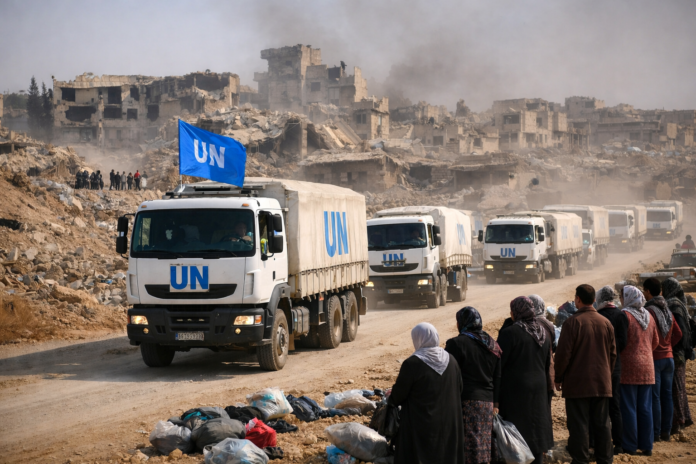

A United Nations (UN) aid convoy has reached the city of Ain al-Arab, commonly known as Kobani, delivering critical supplies.
The delivery, on Monday, comes as the UN reported that over 170,000 people have now been displaced across northeast Syria.
Second major UN aid in a week reaches besieged Kobani city
Stéphane Dujarric, UN Spokesperson confirmed in a statement that the convoy, comprised two dozen trucks and a mobile clinic. It carried ready to eat food, health supplies, and fuel.
This marks the second such convoy to reach the Kobani area within a week, where communities currently face acute shortages of water. They also face shortages of medical supplies, food, and communications.
Findings by Charity Journal reveals that the humanitarian situation in northeast Syria continues to deteriorate rapidly. On January 26, the first UN aid convoy reach the area since fighting kicked off between Syrian government forces and the Kurdish-led Syrian Democratic Forces.
The UN noted that the fighting has forced more than 170,000 individuals from 178 communities to flee their homes. Additionally, vast majority of the displaced are women and children, who face heightened risks of violence and abuse.
“Most displaced families, nearly three in four are sheltering with host communities. this has placed immense additional strain on housing, water, and basic services in areas already facing severe challenges.”
Dujarric further explained that while some families have returned home, many remain displaced due to ongoing hazards. This included explosive ordnance, damaged infrastructure, and a lack of access to essential services.
UN convoy provides relief in north-eastern Syria
In a separate operation on Sunday, a 50-truck UN convoy transported aid from Damascus to the city of Qamishli in Hasakeh Governorate. This was the third major convoy to reach the region in the past week.
Humanitarian agencies have provided assistance to more than 150,000 people in the northeast since the recent escalation began.
The UN stated that advance missions from the OCHA, the UNDP, and the Department of Safety and Security recently assessed road conditions to ensure safe passage. The World Health Organization (WHO) also conducted a technical mission to examine facilities and access routes.
Additionally, the Secretary-General, Antonio Guterres, has welcomed the recent agreement between the Syrian government and the Syrian Democratic Forces (SDF). He appealed to all parties to swiftly implement the pact, emphasizing the peaceful integration of northeast Syria.
He emphasize the rights of Syrian Kurds, and the safe, dignified, and voluntary return of the displaced. He further urged all sides to uphold their commitments, prioritize regional stabilization, and ensure the protection of civilians.
The International Committee of the Red Cross (ICRC) has raised concerns over the worsening humanitarian crisis in northeast Syria. The organisation states that civilians continue to bear the impact of the crisis as families flee with limited access to basic services.
Meanwhile, more than 170,000 people have been displaced following clashes linked to the Northeast Syria conflict in Aleppo, Hasaka, and Raqqa. The United Nations Office for the Coordination of Humanitarian Affairs (OCHA) confirmed the mass displacement on Tuesday, January 27, 2026.