

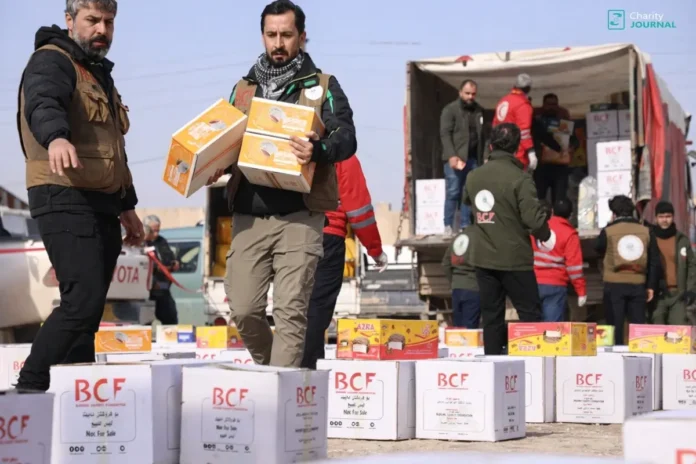

The Kurdish National Council in Syria (KNCS) has highlighted the Barzani Charity Foundation’s role in supporting survivors of the 2023 Afrin earthquake three years later. The anniversary statement recognised emergency relief delivered to affected communities in Afrin and nearby districts.
Barzani Charity Foundation supports the Afrin earthquake survivors
On the third anniversary of the Feb. 6, 2023, earthquake, the Afrin Local Council of KNCS highlighted the humanitarian role of the Barzani Charity Foundation, according to a report. The statement noted that the organisation’s first aid convoy entered Afrin days after the disaster.
KNCS said the 7.8-magnitude earthquake that struck Türkiye and Syria on Feb. 6, 2023, caused tens of thousands of deaths and widespread destruction. The Afrin region, particularly Jindires, experienced severe damage, with about 80 percent of buildings destroyed.
The council stated that on Feb. 10, 2023, the first humanitarian convoy from the Barzani Charity Foundation crossed through the Bab al-Salameh border crossing into Afrin. It described the convoy as the earliest charitable response to reach the affected population locally and internationally.
“When the humanitarian convoy was welcomed at the gates of Afrin, thousands of women and men came out carrying the Kurdistan flag, with tears of joy,” said the Afrin Local Council, KNCS. “It was like a national celebration, and its significance greatly raised morale among our people.”
KNCS added that the Barzani Charity Foundation later expanded humanitarian assistance beyond Afrin and Jindires to Aleppo, Damascus, Kobani, and the Jazira region. The council indicated that support could continue in the future depending on conditions on the ground.
Humanitarian operations in Syria remain complex due to displacement, infrastructure damage, and access limitations. Similar emergency coordination challenges were highlighted in coverage of mine-action collaboration involving international agencies in the country.
Diplomatic engagement and broader regional context
The KNCS statement also referenced diplomatic activities by the Kurdish leadership aimed at amplifying the concerns of Syrian Kurds internationally. It cited participation in global forums and engagement with decision-making institutions as part of broader advocacy efforts.
KNCS said these diplomatic initiatives contributed to dialogue on political solutions that could recognise Kurdish rights within Syria’s constitutional framework. The council linked humanitarian relief with longer-term reconstruction and governance discussions.
Separate remarks from KNCS representatives described mediation efforts that helped prevent escalation toward ethnic conflict in western Kurdistan. Officials reported dialogue with authorities in Damascus, who acknowledged past injustices against Kurdish communities and expressed willingness to pursue reform through negotiations.
Humanitarian access and civilian protection continue to shape international attention on Syria’s evolving crisis. Broader global concern about civilian safety in conflict settings has also been reflected in Charity Journal’s reporting on humanitarian law protections for civilians during armed conflicts, as highlighted by the International Committee of the Red Cross.
KNCS concluded its anniversary statement by offering condolences to the families of earthquake victims. The council also expressed appreciation to the Barzani Charity Foundation and Kurdish leadership for ongoing humanitarian and diplomatic engagement.