



In Nigeria’s oil-rich city of Port Harcourt, a nimble financial technology company is expanding access to global payment systems for Nigerians. As the country’s traditional banking infrastructure falters, Dantown has emerged as a vital utility for Nigerians keen on participating in the global ecosystem.
From a swanky HQ, Dantown CEO Chimene Chinah says the mission is less about competing with the old guard and more about connecting the globe financially. In an interview with Charity Journal, Chimene detailed Dantown’s vision, disclosing that the company is making keen progress amid a raft of headwinds typically associated with doing business in Africa’s largest economy.
Using trust to build a solid reputation
Nigeria is, by almost any metric, a low-trust environment. Chimene revealed to Charity Journal that the switching cost for customers is famously low, with one failed financial transaction capable of triggering a long-standing customer against an institution.
Without the option of brick-and-mortar offices where customers can go to vent their frustrations, Dantown has had to build its reputation on the invisible strength of its monitoring systems. To achieve this, the company has ingrained a culture where uptime remains a priority, tracking the finality of each transaction during processing.
“We try to ensure that when transactions fail, we resolve even before the customers reach out,” said Chimene.
This proactive stance is a radical departure from the reactive, often indifferent posture of financial institutions in the country.
At the heart of this reliability is Monibridge, a subsidiary of the Thoth Group, Dantown’s parent company. The B2B payment solution began as an internal engine that paired customers with merchants to process naira payments during the years Nigeria’s apex bank restricted banks from doing business with cryptocurrency service providers.
In the years since the regulatory witchhunt, Monibridge has morphed into a payment aggregator supporting local businesses to receive and make payments. Building on the lessons from navigating Nigeria’s murky regulatory waters, Dantown leans heavily on multiple service providers.
“So if one is down, it doesn’t affect the business,” added Chimene. “Where we stand out is ensure that we eliminate downtimes due to a single provider issue.”
Dantown: The One-Dollar Card
While Dantown’s focus on reliability has earned it the trust of a growing user base, the company has its eyes on spearheading global financial inclusion for Nigeria. For Dantown, the lowest-hanging fruit to bring it one step closer to its goal was a virtual dollar card.
In 2024, Dantown unveiled its one-dollar virtual card at a time when local cards were systematically rejected for international payments. The launch earned it a reputation as Nigeria’s most affordable virtual dollar card without the hassle of funding and decline fees.
Peering from a business lens, the move to introduce the cheapest dollar virtual card in Nigeria appears to be a calculated market grab. In reality, a bird’s eye view reveals the launch was an act of digital activism.
By lowering the barrier to global entry to a single dollar, Dantown has provided a financial global passport to the excluded. This is the heart of the social mobility narrative that the legacy banks have largely ignored, with Chimene noting that global spending is a key pillar of Dantown’s global service strategy.
Using the one-dollar card, a freelancer in a secondary city like Aba or Kano can now access Coursera for skill acquisition or AWS for infrastructure.
“With the almost free dollar card, Nigerians can onboard easily and spend globally without having to pay dearly for it.”
Furthermore, by integrating USDC and USDT wallets that function across multiple networks, Dantown is bypassing the traditional bottlenecks of foreign exchange. The company’s suite of services allows Nigerians to receive value in stablecoins and spend in fiat, creating a seamless loop that ignores the friction of local currency volatility.
Dantown is making a strategic investment in people
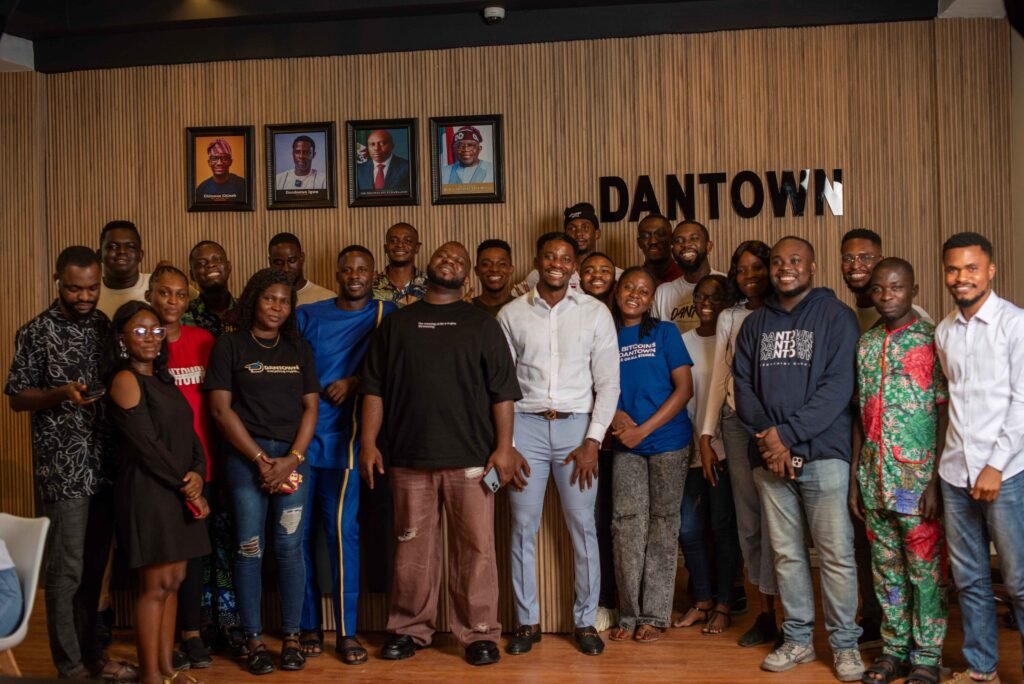
The most quiet, yet perhaps most significant, part of this utility is the human infrastructure built through the Dantown internships and Graduate Trainee programs. For Dantown’s top leadership, the goal was to provide a launchpad for talented Nigerians to begin their professional careers.
Chimene disclosed that Dantown is aware of the raft of challenges currently plaguing job seekers in the country, with sky-high levels of unemployment. At the top of the pile is the inability of job seekers to find companies that will look past their inexperience.
By absorbing raw talent and giving them a vision to key into, the fintech provides a veritable starting career point for scores of Nigerians. Since its launch, Chimene confirmed that multiple cohorts have passed through the Graduate Trainee program, with promising participants offered full-time roles.
Beyond providing a launchpad for job seekers, Dantown’s leadership has adopted a stance of giving back to the local community. The company has backed several philanthropic initiatives while sponsoring local sports tournaments as part of its corporate social responsibility.

Hard tech for hard times
Despite institutional shortcomings, Dantown’s heroism is not tied solely to the system’s failure. Its success hinges on building something that the old guard simply cannot replicate: a culture of radical accountability and high-redundancy engineering.
In the final accounting, Dantown is breaking the mold of the typical run-of-the-mill fintech. Its successes are proof of concept for a different kind of Nigeria where the tech is resilient, and borders are entirely optional.
“As the world crunches into a small global village, there is a rising need for platforms that will act as financial global passports, giving users the freedom to use financial services beyond their borders,” remarked Chimene.