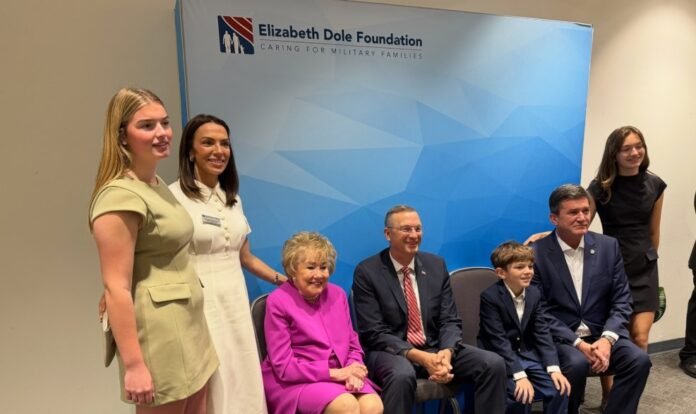

GiveCare founder Ali Madad joined policymakers and caregiving advocates at the Elizabeth Dole Foundation’s 11th Annual National Convening to make a case for the responsible adoption of artificial intelligence(AI). Madad told Charity Journal that the central challenge for AI in caregiving is building a tool that stays useful and honest amid rising acceptance levels.
AI that meets caregivers where they are
The Elizabeth Dole Foundation, a Washington-based nonprofit, has launched its National Blueprint for Action designed to bolster support for military and veteran caregivers in the US. Seeking to translate the blueprint from a policy document into a coordinated national strategy, the launch garnered attendance from policymakers, business leaders, and service organizations
Today, we launch the National Blueprint for Action, a practical, solutions-driven roadmap to strengthen support for America’s 14.3 million military and veteran caregivers.
The result is a blueprint comprised of 136 evidence-based recommendations. pic.twitter.com/ordVU7QBcq
— Elizabeth Dole Foundation (@DoleFoundation) May 19, 2026
Madad joined a morning panel alongside representatives from the Caregiver Action Network, BCG Federal Corporation, and OpenAI. Leaning on his work at GiveCare, Madad argued that AI developers should ensure proper guardrails are in place before a public rollout to protect careworkers and their patients.
“Caregiving is where AI has to grow up,” said Madad. “The useful version of AI should protect the caregiver, respect the care recipient, and make the human system around them easier to reach.”
GiveCare develops safety-focused AI systems for family caregivers, including InvisibleBench, an open-source evaluation framework that tests how AI systems respond across extended caregiving conversations.
The framework specifically tests for missed crisis signals, brittle advice, unsafe follow-up, and responses that fail to account for the real conditions families are living in. Madad released InvisibleBench and an accompanying open-source safety framework in November 2025, positioning it as a tool for researchers, healthcare organizations, and policymakers to evaluate caregiving AI before deployment.
A VA Inspector General report released in January 2026 identified a potential patient safety risk in how the Veterans Health Administration deploys generative AI chat tools in clinical settings, finding no formal system tracks whether these tools put veterans at risk.
GiveCare: From evaluation to regulation
Madad told Charity Journal that InvisibleBench is designed to make AI safety less abstract for policy advocates. When advocates can see exactly where a caregiving AI fails in realistic multi-turn scenarios, whether it misses an escalation signal, gives advice that collapses under follow-up questions, or fails to handle veteran-specific context, those failure points become concrete procurement requirements and audit criteria rather than general concerns.
The goal, Madad said, is not to regulate AI in the abstract but to require evidence that a system can handle the messy, high-stakes conversations caregivers actually have before it reaches federal veteran care networks. That framing positions InvisibleBench as a pre-deployment gate rather than a post-hoc accountability tool, a distinction that matters significantly in environments where trust is hard to rebuild once broken.
Designing for the caregiver’s real environment
Madad told Charity Journal that GiveCare’s SMS-first architecture reflects a deliberate choice to design around the caregiver’s actual constraints rather than the capabilities of the most sophisticated users.
Many family caregivers operate under time, bandwidth, privacy, and device limitations, particularly in underserved or high-strain environments. Meeting them through basic texting lowers the barrier to support while the backend still applies safety checks, escalation pathways, and trauma-informed response patterns.
For founders building tools for similar populations, Madad’s framework is a straightforward one. The GiveCare founder urges them to start with the real environment, then add AI only where it demonstrably improves reliability and reduces burden.
He noted that adding features that require a smartphone, a stable internet connection, or extended attention from someone already stretched thin defeats the purpose before the tool reaches anyone.
AI utility in 2026 has reached frenetic levels, with nonprofits and foundations leaning on the technology for its productivity and efficiency gains. J&Y Law noted in an interview with Charity Journal that AI saves 320 hours per week, allowing the law firm to improve service delivery for its growing client base.