
The Global Uplift Project has surpassed 5 million people helped across developing countries after completing its 687th project, a school borehole in Cameroon. The nonprofit’s founder, Robert Freeman, disclosed that its long-term impact depends on requiring local communities to invest in projects themselves rather than relying entirely on outside donors, a strategy he believes improves sustainability and local ownership.
The Global Uplift Project expands its reach across 26 countries
The Global Uplift Project, a California-based nonprofit founded in 2007, has built hundreds of education and community infrastructure projects across Africa, Latin America, and South Asia. The organization marked its latest milestone after completing a water project for a primary school in Cameroon, pushing the number of people reached by its programs beyond 5 million.
TGUP focuses on projects that improve educational access and basic living conditions in underserved communities. Its portfolio includes classrooms, libraries, science laboratories, kitchens, sanitation facilities, and water infrastructure.
The organization completed 130 projects over the past year alone, averaging one project every three days. Beyond physical infrastructure, The Global Uplift Project also operates its Save a Girl™ initiative, which has distributed more than one million reusable sanitary pads to adolescent girls in 11 countries to help reduce school absenteeism linked to menstruation.
“Every TGUP project either reduces suffering or improves opportunity for the poorest people in the world,” Freeman said.
The milestone comes as development organizations continue to prioritize investments that improve educational outcomes, water access, and gender equity in low-income communities.
Why community investment matters for long-term success
While many international aid programs struggle with sustainability after initial funding ends, Freeman said TGUP intentionally requires local participation before approving projects.
“We require at least 10% participation by local communities in all projects we carry out,” he told Charity Journal. “We want to see that the locals really want it.”
According to Freeman, some communities contribute as much as 40% of total project costs. TGUP also reviews plans for ongoing maintenance and funding before committing resources.
The approach reflects a broader shift within the nonprofit sector toward community-led development. Development experts have increasingly emphasized that projects tend to deliver stronger long-term results when local stakeholders contribute financially, participate in planning, and retain ownership after construction is complete.
For schools and communities with limited resources, that model can help ensure that new facilities remain operational years after donors have moved on to other priorities. The organization funds its projects from public and private donations, with its transparency standards earning it a four-star rating on Charity Navigator.
Science Lab in a Box targets education gaps across East Africa
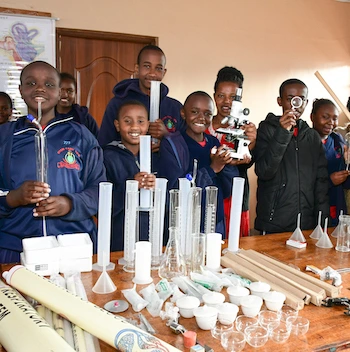
TGUP’s next major expansion centers on its Science Lab in a Box™ program, which provides laboratory equipment and curriculum materials that allow students to conduct practical science experiments.
The initiative currently serves approximately 200,000 high school students in Uganda and is now expanding into Kenya. Each laboratory package costs $1,800 and includes equipment for biology, chemistry, and physics instruction.
Freeman believes philanthropic foundations and corporate partners can accelerate the program’s growth by funding laboratory deployments at individual schools.
“Our track record in Uganda is exemplary and very well documented,” he said. “After Uganda and Kenya, there are 52 other countries in Africa that need SLaB.”
The expansion highlights a persistent challenge across many African education systems: limited access to practical science instruction despite growing demand for STEM skills. By providing low-cost laboratory infrastructure, programs like Science Lab in a Box aim to give students hands-on learning opportunities that many schools would otherwise struggle to afford.
As governments, foundations, and nonprofit organizations search for scalable education solutions, TGUP’s model offers a relatively low-cost approach that combines infrastructure, curriculum support, and local partnerships to reach underserved students.