


The International Federation of Red Cross and Red Crescent Societies (IFRC) has released its 2025 annual report, noting that sharp humanitarian funding cuts collided with rising global crises. The cuts forced the world’s largest humanitarian network to deliver aid under increasingly difficult conditions while accelerating reforms to strengthen locally led responses.
A pivotal year for the IFRC
In its 2025 Annual Report, the IFRC said its 191 National Societies continued responding to earthquakes, floods, droughts, epidemics, conflicts and other emergencies despite worsening financial pressures. The organization described 2025 as a “pivotal year” that tested both communities and humanitarian organizations worldwide.
“If funding cuts were earthquakes, the one that struck in early 2025 was “The Big One,” said IFRC CEO Jagan Chapagain. “Its consequences and financial aftershocks throughout the year made delivering humanitarian support harder, just as humanitarian needs escalated.”
The report highlighted the growing dangers confronting humanitarian workers, revealing that 27 volunteers and staff were killed while on duty during 2025. Twenty-four died in violent attacks despite their identification as Red Cross or Red Crescent personnel, while three died in accidents.
The fatalities spanned across Palestine, Iran, Sudan, the Democratic Republic of the Congo, Ethiopia and South Sudan. The IFRC dedicated the annual report to those workers and renewed calls for stronger protection of humanitarian personnel.
Meanwhile, extreme weather accounted for roughly three-quarters of the IFRC’s operations during the year, prompting the organization to expand climate adaptation and resilience initiatives. The federation launched a Global Climate Resilience Platform Pooled Fund to provide flexible financing for locally-led climate projects and continued supporting more than 50 National Societies through its Climate Action Journey.
The IFRC 2025 report also highlighted new climate partnerships, including a 10-year Alliance for the Amazon programme and projects aimed at improving resilience in small island developing states.
IFRC 2025 Report: Migration, health and preparedness remained priorities
The federation said it assisted around 18 million migrants across more than 160 countries during 2025 while launching a Global Migration and Displacement Platform that aims to mobilize 500 million Swiss francs by 2030 to support migrants, refugees, internally displaced people and host communities.
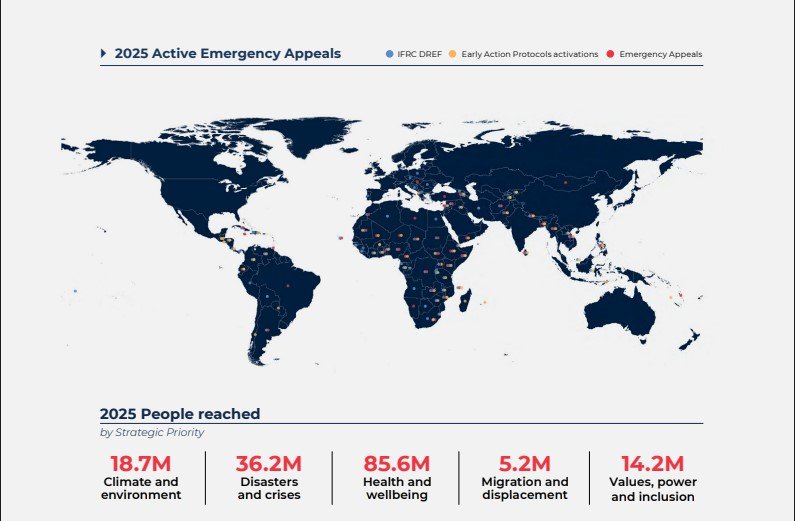
In health, the IFRC reported that its Universal First Aid App surpassed one million downloads, while public health programmes helped vaccinate 3.8 million adults and reached more than 13.9 million people through immunization campaigns across Africa. The organization also expanded epidemic preparedness, cholera prevention and community health programmes.
The 100-page report estimated the economic value of the IFRC’s global volunteer network at approximately $13.5 billion annually, underscoring the role volunteers play in delivering humanitarian assistance worldwide.
Despite financial headwinds, the federation said it continued investing in digital transformation, emergency preparedness and locally led humanitarian action, arguing those efforts would help National Societies respond more effectively to future crises.