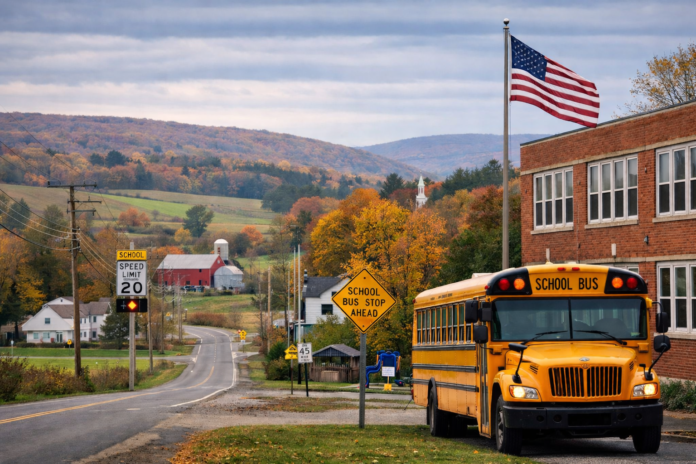

Rural school districts in New York are sounding the alarm over Governor Kathy Hochul’s proposed 2026 executive budget. The Rural Schools Association of New York State (RSA) say the 1% increase in state school aid ignores the reality of rising operational costs.
Rural school districts warn of devastating consequences
David Little, executive director of the RSA, said the flat increase fails to cover basic inflation, much less the sharper rises districts face in health insurance premiums and pension contributions. Furthermore, he warned that without legislative intervention to increase funding, districts will be forced to slash programs and lay off staff.
“If the legislature is unable to negotiate upwards on this, you’re going to see a great deal of slashing of programs, laying off of school staff,” said David Little, executive director of the RSA.
The criticism emerges as the RSA releases “The Hard Work of Staying,” a new report identifying inadequate funding as the primary challenge confronting rural districts. Additionally, Little emphasized that funding cuts could not come at a worse time, noting that the current generation of students spent crucial formative years in isolation during the COVID-19 pandemic.
The criticism emerges as the RSA releases “The Hard Work of Staying,” a new report identifying inadequate funding as the primary challenges confronting rural districts.
“School is like a handicap ramp. It steadily increases. It builds on itself,” Little said. “If you start out with children that have learning deficits and you don’t do anything about it, that stays with them their entire lives.”
Little said the proposal ignores a $2 million Rockefeller Institute study outlining funding based on current student needs. The state commissioned this analysis yet has implemented fewer than five of the report’s more than 30 recommendations.
Unfunded mandates compound financial pressures
Rural districts are grappling with the state’s mandates totransition to zero-emission electric bus fleets without adequate support. The RSA report highlights a critical infrastructure gap that makes compliance nearly impossible under current conditions.
Little noted that utility companies have informed districts they lack the gris capacity to charge entire fleets. He said charging 25 electric school buses uses as much power as a Super Walmart, according to estimates.
“The entire proposal—no funding, no power, no ability for local taxpayers to pay for this—is absolute financial folly,” said David Little, executive director of the Rural Schools Association of New York State.
The report argues that without state support, these mandates put districts in impossible positions. They must choose between hiring School Resource Officers for safety or funding educational programming.
Similarly, UK charities face challenging times with funding constraints affecting their operations.
The RSA’s study reveals that rural districts are experiencing unprecedented increases in student needs following the pandemic and economic upheaval. Districts report that identifying special needs in incoming students has risen to 50%, up from pre-pandemic levels.