

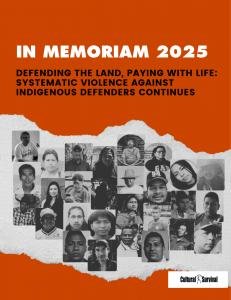

A new report from Cultural Survival has branded Latin America as the most dangerous region in the world for people who defend land and territory. In 2024, 82% of the 146 documented murders of land took place in the region amid failing safeguards to prevent the killings.
Cultural Survival highlights the cost of defending the land in new report
At the 25th session of the UN Permanent Forum on Indigenous Issues, Cultural Survival released an advocacy brief titled “Defending the Land, Paying with Life.” The document analyzes the structural conditions behind the murders of Indigenous land defenders across Latin America and sets out recommendations for states, companies, and international bodies.
The brief comes on the heels of Cultural Survival’s annual “In Memoriam” report, published in March, which named and honored individuals and Indigenous defenders killed in 2025. Each person documented in the report lost their lives for protecting forests and waterways and resisting extractive projects, causing environmental destruction.
Per the report, Mexico and Colombia sit at the center of the analysis. Both countries have formal protection mechanisms for defenders, yet the killings continue alongside threats, kidnappings, and digital attacks designed to make defense work impossible.
“Every name in this report is a universe that was extinguished, a language, a territory, a form of knowledge that the world will never recover,” said Alicia Moncada, a Wayuu woman and Cultural Survival’s Director of Advocacy and Communications.
Why existing protections fall short
The problem with current protection mechanisms, according to Cultural Survival is not simply one of resources. According to Moncada, the existing protection mechanisms in Colombia and Mexico were designed for urban context, neglecting the lived realities of Indigenous defenders.
“Neither the resources, nor the logistics, nor the timelines account for the realities of rural and Indigenous communities, nor for the collective nature of Indigenous territorial defense,” Moncada told Charity Journal.
Cultural Survival is calling on both governments to open dialogue with Indigenous Peoples and civil society organizatios to redesign these mechanisms. The organization is pushing for protective measures built around Indigenous governance structures, designed for collective rather than individual protection.
Meanwhile, Cultural Survival is pushing for the protection measures tailor-made for geographic realities far from urban centers. The organization is also pressing both countries to co-design mechanisms with Indigenous Peoples rather than unilaterally present fixed solutions.
Making the leap from voluntary to binding
Cultural Survival’s recommendations extend beyond states to corporations operating in or near Indigenous territories. The brief calls on companies to implement human rights due diligence policies that cover the entire value chains.
These policies include accessible redress mechanisms and also the prohibition of the use of legal actions to criminalize territorial defense.
The organization has documented cases including the FICO railway in Brazil and Sigma Lithium operations that illustrate a pattern it says repeats across regions and sectors. Furthermore, Cultural Survival has highlighted extractive and infrastructure projects advancing without the Free, Prior and Informed Consent, with communities who resist paying the consequences.
“Voluntary compliance has consistently proven insufficient while communities bear the consequences, and there is no meaningful accountability when things go wrong,” said Moncada. “The goal is not just stronger laws, but laws that are shaped by communities most affected by their absence.”
Meanwhile, Cultural Survival has launched petitions directed at the government of Mexico and Colombia, each documenting country-specific context. The broader push is for binding human rights due diligence standards, a shift the organization describes as one of the most critical gaps in the currentw framework for protecting Indigenous territorial defenders.