

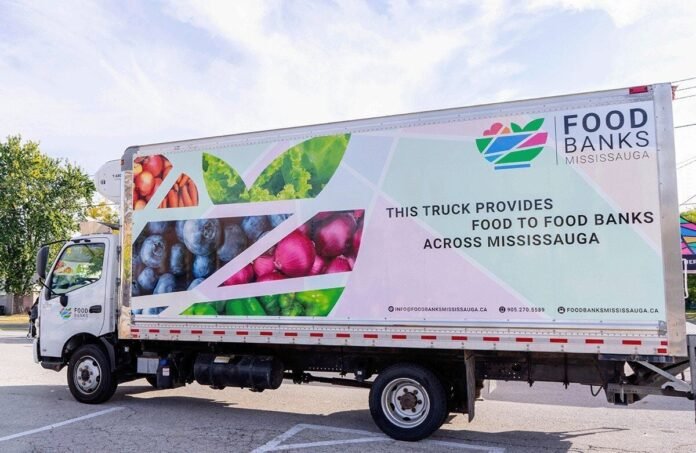
Mississauga, defined by its glass towers and corporate headquarters, is quietly held by a different kind of infrastructure. Food Banks Mississauga, a non-profit that distributes food to a network of over 60 agency partners, has evolved to become the essential “social shock absorber” for a region facing an unprecedented affordability crisis.

The workforce subsidy
The most dangerous myth in the Greater Toronto Area is that hunger is a symptom of unemployment. The reality, however, is that the “New Hungry” are the people who keep Mississauga running.
In the past year alone, Food Banks Mississauga saw a staggering 58% increase in food bank visits, serving nearly 50,000 unique visitors, over 5% of the city’s entire population.
Meanwhile, the Social Return on Investment (SROI) is found in Workforce Preservation. With 1 in 13 Mississauga residents now relying on the food bank, the organization is effectively providing a “living wage subsidy” to the city’s service workers, retail staff, and office administrators.
By covering the cost of survival for those whose wages are swallowed by rent, they prevent temporary financial stress from turning into permanent homelessness.
“Food insecurity in our city continues to worsen, and folks who are most at risk continue to bear the brunt of the increased cost of living and inflation,” said Meghan Nicholls, CEO, Food Banks Mississauga. “Neighbours in need are accessing food support services more frequently, and those who rely on food support are struggling to get back on their feet and are relying on us for longer.”
Logistics as a systemic advantage
It is easy to view Food Banks Mississauga as merely a collection of pantries. However, a bird’s-eye view tells a different story, with the organization fitting into the mold of the city’s most sophisticated logistics engine.
Managing a network of over 60 agencies, Food Banks Mississauga has built a “Social Supply Chain” that distributed over 9 million pounds of food last year. With sheer radical efficiency, they manage a massive cold-chain operation, ensuring that fresh, nutritious food makes up a significant portion of their distribution.
In a world of rising food costs, this ability to procure and distribute at scale is the ultimate return for any social investor. Food Banks Mississauga saved nearly 5 million kilograms of greenhouse gas emissions in 2025, rescuing 3.1 million pounds of food via its network.
Apart from the sheer efficiency of its logistics network, Food Banks Mississauga expanded its reach by offering a tax clinic, injecting $2.65 million into the local economy through refunds and credits.
Food Banks Mississauga: The intelligence of advocacy
Beyond the warehouse, Food Banks Mississauga acts as the city’s Economic Intelligence Agency. Every one of the over 500,000 visits recorded in the last year provides a real-time data point on the health of the local economy.
This data is actually the foundation of their advocacy. Their reports are the only voice speaking truth to the structural failures of housing and income policy in Ontario.
Beyond the surface, the productivity Mississauga enjoys in 2026 is a dividend paid for by the crates of produce moving through the central warehouse every morning, ensuring that the people who build the city can actually afford to eat in it.