

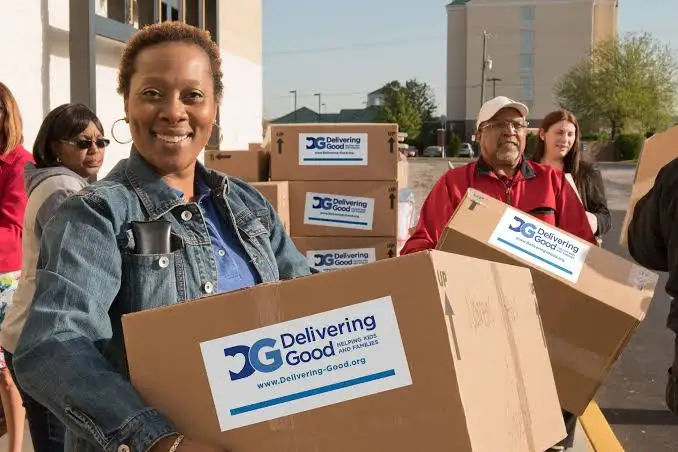

After Fast Company released its 2026 Annual List of Innovative Companies, US-based nonprofit organization Delivering Good stood alongside Google and Nvidia for its attempts at transforming aid delivery. The organization earned its spot by merging the logistical precision of a Fortune 500 company with the empathetic mission of a frontline nonprofit.
Over the last 18 months, Delivering Good has focused on two key innovations designed to reshape how the product-giving sector delivers and measures impact. Leaning on the Basic Comfort Pack and the GOOD Index, the 41-year-old organization is keeping up with the lightning pace of innovation.
Dignity as a first responder with the Basic Comfort Pack
When a natural disaster hits, the first 48 hours are a psychological battlefield. Several studies indicate that this timeframe “holds the key to managing natural disasters,” and prioritizing early coordination and resource allocation improves survival metrics.
This is where the Basic Comfort Pack enters the frame. Unlike the fragmented and random donations of the past, these packs are standardized, pre-curated solutions designed for speed, and most importantly, dignity.
“In those first 48 hours, even small moments can make a meaningful difference,” said Delivering Good CEO Matthew Fasciano. “What we’ve seen is that when someone receives something that is new, thoughtfully put together, and ready for them, it creates a sense of care and stability at a time when everything else may feel uncertain.”
The innovation here is the rejection of “second-hand” thinking. By partnering with manufacturers and retailers to curate brand-new essentials like socks, underwear, and blankets, the organization ensures that the first thing a person touches after losing everything is a symbol of their inherent value.
After an impressive debut in Kentucky, early observers hailed the packs as a proactive approach to disaster relief rather than the typical reactive nature of flooding individuals with unwanted, second-hand products.
Beyond the Spreadsheet: The Good Index
While Delivering Good has found success with its Basic Comfort Pack, the incoming launch of the Good Index cemented its place on Fast Company’s annual list of the world’s most innovative companies of 2026.
Historically, the nonprofit sector leaned heavily on outputs. Aid organizations fretted constantly about the number of shirts and boxes shipped, but while these metrics look good on annual reports, they say nothing about the recipients’ actual well-being.
The GOOD Index will be the first-of-its-kind framework designed to measure social impact based on real human outcomes. Supported by an incoming digital platform, the Index allows Delivering Good and its partners to track how product donations translate into tangible human progress.
“We’ve become more intentional in designing solutions, not just delivering support,” Fasciano explains.
By quantifying the intangible benefits of new merchandise, Delivering Good is providing its corporate partners with something more valuable than a tax write-off. A bird’s-eye view reveals that they are building the foundations of a data-driven map of social ROI, changing the landscape of aid delivery.
Delivering Good aims to impact 50 million lives by 2035
The organization’s North Star is a bold one, with Fasciano disclosing plans to impact 50 million lives by 2035. To reach this scale, Delivering Good is systematically dismantling the barriers that have historically kept the nonprofit sector siloed.
For Fasciano, the primary barrier is not a lack of resources but an absence of integrated infrastructure. The CEO disclosed that there is a “tremendous amount of good happening across this sector,” providing a foundation to build upon.
At the moment, Delivering Good is positioning itself as an impact platform. Whether through the TeamLab initiative for collaborative research or multi-sector partnership with firms like Accenture, they are building a leadership pipeline that allows smaller community partners to tap into a global supply chain of hope.
This Fortune 500 approach is perhaps most evident in Fasciano’s advice to other nonprofit leaders. He argues that the first step to innovation is not a massive capital injection but a mental pivot.
“Innovation is more attainable than it might seem,” added Fasciano. “It starts with taking an honest look at what you do well, where you can improve, and understanding the ‘why’ behind both.”
As Delivering Good prepares for the Fast Company Most Innovative Companies Summit in May, the message for the industry is clear: The era of “good enough” is over.