

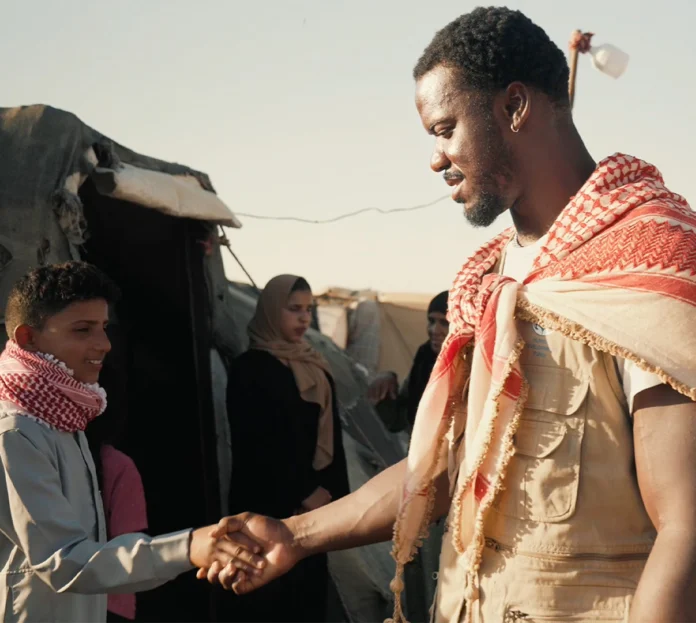

Houston Texans linebacker Azeez Al-Shaair joined the Human Development Fund on a week-long humanitarian visit to Jordan, where he met displaced Syrian families and children receiving prosthetic limbs. In an interview with Charity Journal, HDF said the visit will give public figures a firsthand understanding of humanitarian crises rather than serve as a fundraising campaign.
Human Development Fund uses athlete visits to amplify humanitarian stories
The Human Development Fund, a nonprofit delivering humanitarian assistance in more than 30 countries, hosted Al-Shaair in Jordan. The football star visited refugee settlements, joined prosthetic fitting sessions for children displaced from Gaza, and spent time with families living in the Suleiman Center, an orphanage the organization co-founded with Dr. Omar Suleiman.
Field visits involving athletes and other public figures have become part of HDF’s broader effort to increase awareness of long-term humanitarian needs. However, the organization told Charity Journal that these visits are not meant to generate donations during the trip itself.
“Field visits like this one are not a fundraising mechanism,” the HDF team told Charity Journal. “They are an opportunity for people who care about this work, whether they are athletes, donors, or community leaders, to witness it firsthand and carry those stories back to their own communities.”
HDF said previous collaborations with NFL wide receiver Joshua Palmer and content creator FaZe Apex have introduced new audiences to the realities facing displaced families. The organization added that when public figures share authentic experiences, they help sustain long-term programmes funded through recurring donors and institutional partners.
The visit comes on the heels of the Human Development Fund opening a regional office in Jordan to extend its presence in the Middle East.
Long-term partnerships support displaced families beyond emergency aid
Humanitarian organisations increasingly face pressure to move beyond one-time aid distributions as displacement becomes more prolonged across the Middle East. Families forced from their homes often require years of medical care, education, housing support, and psychosocial services long after emergency assistance ends.
HDF told Charity Journal its work in Jordan relies on local field teams and partner organisations embedded within the communities they serve. The approach allows the nonprofit to maintain relationships with families between aid visits instead of treating humanitarian response as a series of isolated interventions.
“Our work with Syrian refugee families is built on long-term local partnerships rather than one-time distributions,” the organisation told Charity Journal. “We maintain continuity, with our mission of supporting instead of replacing, to ensure families are not treated as case files but as neighbours.”
The nonprofit said it follows a similar model for families displaced from Gaza through its separate relief programme, focusing on sustained engagement instead of short-term emergency response.
Prosthetic care remains a growing humanitarian need
The visit also highlighted the continuing need for specialised rehabilitation services for children injured by conflict. During the week, Al-Shaair joined HDF teams as displaced children from Gaza received new prosthetic limbs, an area the organisation said forms part of its wider medical assistance programme.
According to HDF, prosthetic and rehabilitation services depend on continued support from recurring donors and institutional partners because recovery extends well beyond the initial fitting. Children often require ongoing adjustments, therapy, and follow-up care as they grow.
For humanitarian organisations working with displaced communities, maintaining those long-term medical services remains one of the most difficult challenges. While high-profile visits can draw attention to the issue, HDF told Charity Journal that lasting impact depends on sustained local partnerships and consistent investment in the families who continue living with the consequences of conflict.