

In the mist-shrouded eastern highlands of Zimbabwe, the Chimanimani Mountains stand as both a breathtaking monument to nature and a silent witness to a recurring tragedy. For decades, the relationship between the people of this valley and the slopes above them has been governed by a dangerous misunderstanding of the land.

Now, a local movement spearheaded by Peza Trust hopes to mend the fracture by establishing a biodiversity learning center in Chimanimani. Dubbed the first-of-its-kind in Zimbabwe, building the biodiversity learning center is an uphill climb for Peza Trust, but local community support is providing a tailwind to bring the project to completion.
The anatomy of a disaster
Chimanimani’s history and landscape amplify the need for a biodiversity learning center. Since the start of the millennium, the UNESCO Biosphere Reserve has borne the brunt of two devastating cyclones, leaving destruction in its wake.
During Cyclone Idai in 2019, hundreds of lives were lost as the mountainsides seemingly liquefied, sending torrents of mud and boulders into the villages below. Back in 2000, Cyclone Eline hit the Eastern coast of Africa, rendering 15,000 people homeless as the storm tore through Zimbabwe.
While locals viewed both disasters as an unavoidable act of God, ecologists opine that the systematic destruction of the mountain’s natural defenses magnified the impact of the cyclones. Annual burning of slopes had decimated the native cone grass, a species whose deep root systems act as a biological anchor.
To prevent the destruction of nature’s first line of defense against cyclones, Peza Trust is racing to construct the biodiversity learning center in Chimanimani. Furthermore, Jane High, a team member at Peza Trust, disclosed that the center will educate locals to avoid contaminating rivers from artisanal gold mining activities.
According to High, the center’s curriculum will fill a void left by the national school system, where the critical role of biodiversity is absent from the syllabus. Peza Trust will achieve this by translating complex ecological concepts into Ndhau, Shona, and English to educate students in the area.
“I felt that we need to be certain that every child in Chimanimani District learns how mountain ecosystem works to control our precious water resources,” said High. “The current school curriculum does not teach the critical role of biodiversity.”
A foundation built on local solidarity
Aware of the importance of educating Chimanimani’s youth on the importance of protecting nature, Peza Trust set things in motion. The organization purchased a near-derelict building in the middle of Chimanimani village, leaning on a grant by the Beit Trust and augmenting with years of fundraising.
With the purchase complete, work began in earnest to renovate the rundown building. High confirmed a flurry of community support for the renovations, with local donations in the form of timber, paint, and labour pouring in.
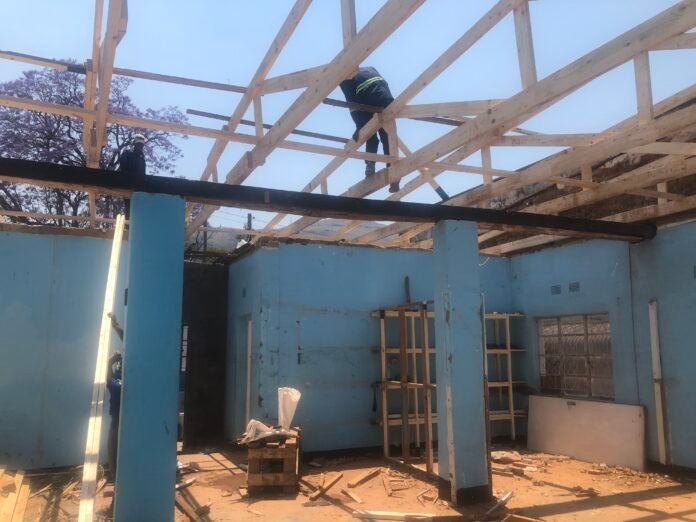
As renovations took off, the team discovered that not only did the roof require replacement, but the existing timber structure was also unsound. The sixty-year-old roof trusses had sustained rain damage, rendering them unfit to support the new roof.
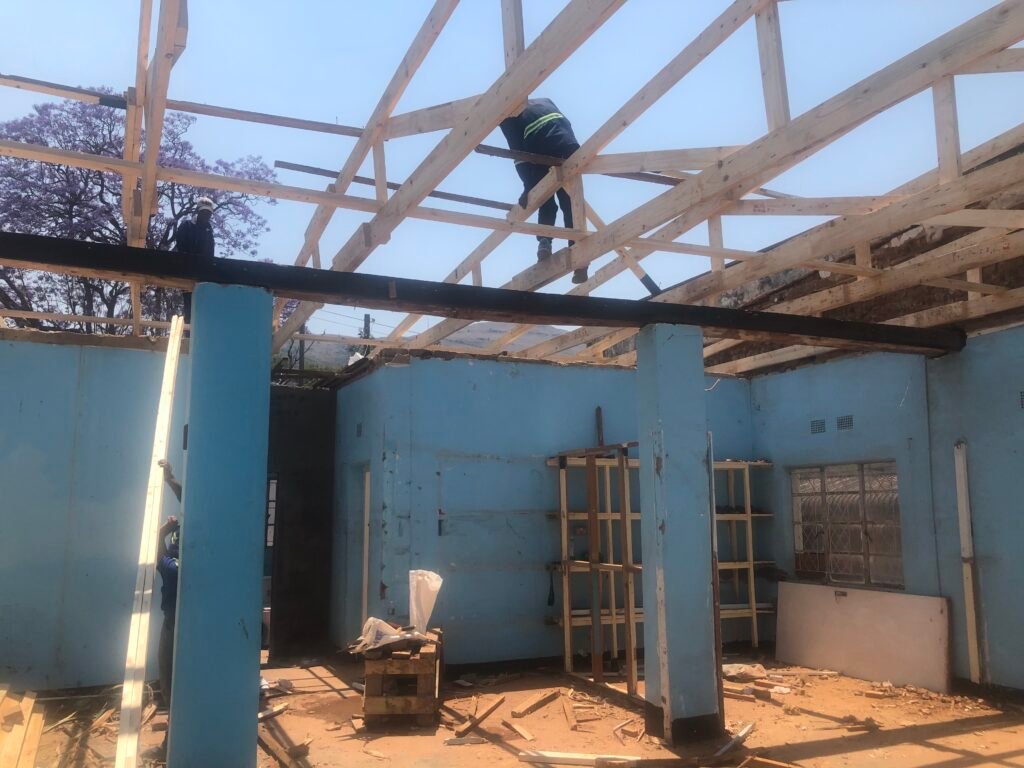
High revealed that sourcing high-quality pine for new trusses is a near-impossible task, given a streak of land reform disputes and arson that have crippled the commercial timber industry. However, local firm Border Timbers, despite facing the threat of liquidation, provided the full amount of sawn timber required for the roof repairs.
In early February, Peza Trust completely replaced the old asbestos roof and completed a five-tier bench for students in the courtyard. Meanwhile, repairs and replacement of doors and toilets are at an advanced stage, with the Peza Trust racing to finish the biodiversity learning center.
Still a long way to go for Peza Trust
Despite the keen progress recorded so far, High notes that the community biodiversity center is still far from completed. There is a pressing need for library shelving and over a dozen computers to support online lessons.
The team is seeking out sponsorship for a Starlink connection for internet access and a smart board for lessons. Furthermore, there is an urgent need for a solar geyser and a solar system for the center to provide electricity for the center.
The transition to renewable energy is an operational imperative. At the moment, the center relies on diesel generators, machines that are loud and costly. By shifting to solar, the center intends to extend its reach beyond schoolchildren, providing a reliable space for adult education and vocational training in the evening.
A clear vision for Chimanimani’s biodiversity learning center
The facility is pragmatically designed for the realities of rural education. With class sizes often exceeding fifty students, the center utilizes a three-port rotating system to accommodate up to ninety children at a time.
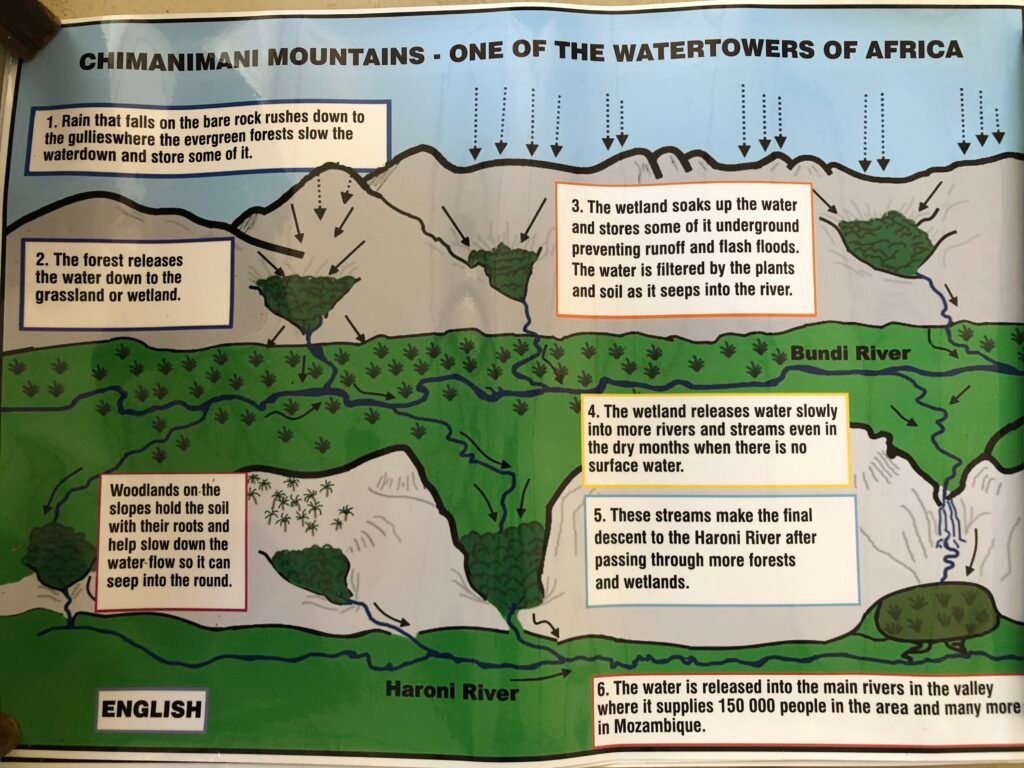
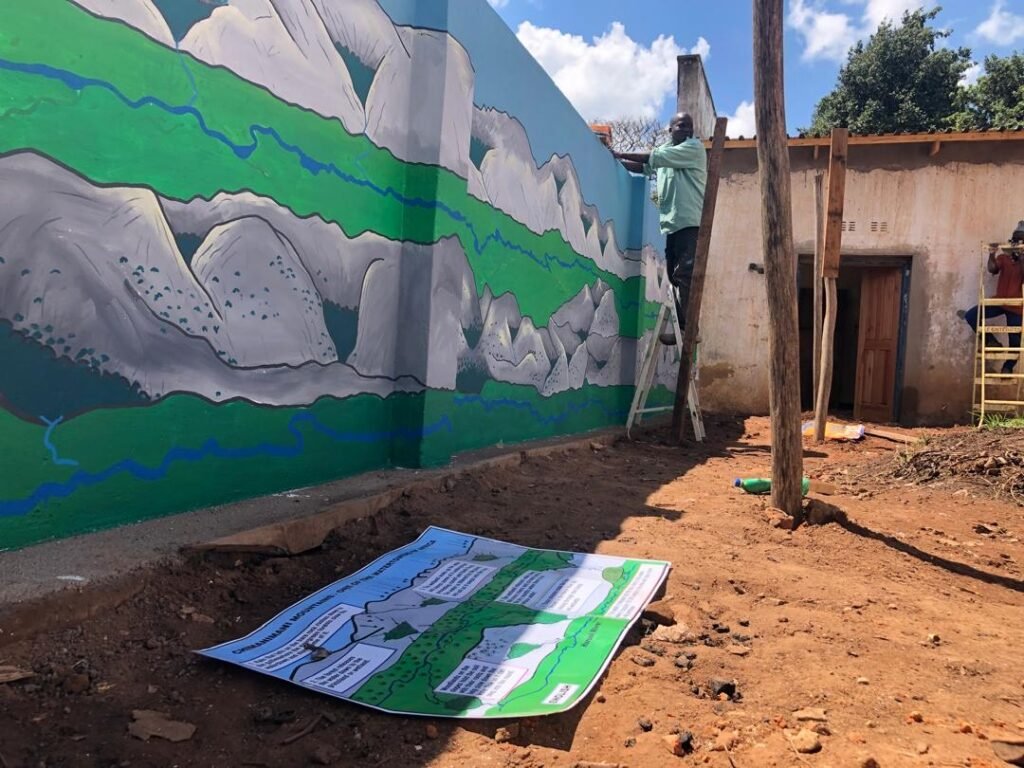
The first group of thirty students will go into the courtyard to learn from the Water Towers Mural, a visual aid showing how mountains protect the environment. There is a translation in Ndhau, Shona, and English to pass the message across to the students.
Another group will participate in the main classroom, using an interactive smartboard for lessons on the three main habitats in Chimanimani and their ecological benefits. The third group will learn outside, in front of the massive biodiversity mural, with lessons on how each species contributes to the protection of the local environment.
Each class will last for 15 minutes, and after all cohorts have gone through each port, they will experience the magnificent Bridal Veil Falls, 2.6km away from the learning center.
A masterclass in community building by Peza Trust
For nonprofit leaders globally, the Peza Trust offers a blueprint for mobilization that eschews top-down aid in favor of long-term integration. With nearly sixteen years in Chimanimani, the Peza Trust has embedded itself in the community, training scores of youngsters with key life skills.
Spurred by Peza Trust’s support and guidance, several Chimanimani’s youth have gone on to become leaders in business while making a name in the national sports scene.
When quizzed on the blueprint for success, High disclosed that earning the community’s trust is crucial. She added that earning trust does not happen overnight, emphasizing the importance of honesty and competence for global nonprofit leaders keen to replicate similar successes.
“Passion, skill, and honesty go together,” said Jane High. “With only one or even only two of these, you should not expect consistent support from your community.”
As the center nears completion, its mission remains focused on the long term. The Peza Trust is focused on planting the seeds of a future where the community and the mountain finally speak the same language.