

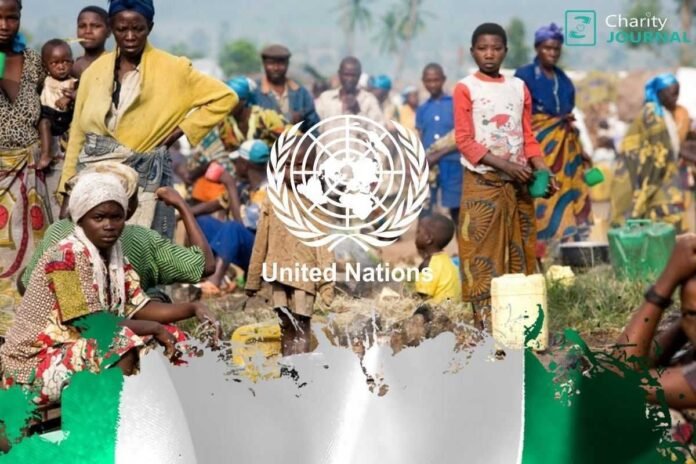

A new United Nations (UN) report has revealed that pervasive poverty is rendering millions of Nigerians vulnerable to conflict, hunger, and disease.
The 2026 Humanitarian Needs and Response Plan from the UN Office for the Coordination of Humanitarian Affairs (OCHA) identified poverty, alongside 16 years of armed conflict, devastating floods, and disease outbreaks, as the core drivers of the catastrophe.
United Nations Says Catastrophic Hunger and Violence Grips Nigeria
The report warns that a lack of access to basic services leaves the population defenceless against shocks.
In the crisis-ridden Borno, Adamawa, and Yobe (BAY) states, the situation is particularly dire. The UN estimates that 5.9 million people will face severe to extreme needs, with 7.3 million requiring some form of assistance.
“Non-state armed groups are increasingly targeting civilians, killing approximately 4,000 people in the first eight months of 2025 alone, a figure matching the total for all of 2023.”
The report also revealed that civilians endure abductions, gender-based violence, forced recruitment, and constant threat from explosive devices.
Findings by Charity Journal reveals that the crisis manifests in gendered sufferings as women and girls face heightened risks of sexual violence and early marriage. Also, the men and boys confront forced recruitment and arbitrary detention.
Floods, Poverty Compound Nationwide Humanitarian Crisis
For many, survival necessitates dangerous behaviour, such as farming in insecure areas.
A nationwide malnutrition emergency is claiming young lives daily. The report states that in the northeast alone, at least 75 children risk death every day without urgent therapeutic care.
Additionally, food insecurity, poverty, and destroyed farmland are forcing families to watch their children waste away.
Similarly, the northwest grapples with extreme food insecurity and violence from armed criminals, which is displacing hundreds of thousands.
“ Efforts to relocate displaced persons to safer areas are failing as attackers repeatedly target the new sites,” the report revealed.
In the Middle Belt, intercommunal and farmer-herder conflicts are also displacing tens of thousands and claiming scores of lives. Underpinning the crisis is multidimensional poverty, which affects over 90 per cent of the rural population in northern Nigeria.
According to the report, climate change is also compounding this vulnerability. catastrophic floods in 2024 killed nearly a thousand people, displaced hundreds of thousands, and destroyed crops that could have fed 13 million people for a year.
In a separate development, the United Nations High Commission for Refugees (UNHCR) has said rampant flooding has displaced over 600,000 people across southern Mozambique. The agency confirmed that waters are still rising and urgent humanitarian access is now the critical challenge.
Meanwhile, in Afghanistan, the United Nations Development Programme (UNDP) has solarized 446 shelters for vulnerable families in Afghanistan. This initiative is part of a larger project of the United Nations High Commissioner for Refugees (UNHCR). The solarization ensures these families have safe, 24-hour power.