
Public Welfare Foundation has launched a $2 million grantmaking initiative to scale community-based alternatives to youth incarceration across Michigan and Tennessee, building on its long-running push to reshape juvenile justice systems in the United States. Ashley Rayment, spokesperson for the Foundation, told Charity Journal that the “Igniting Futures” program focuses on strengthening implementation capacity for local coalitions building non-carceral youth justice models.
Public Welfare Foundation invests in coalition-driven youth justice reform
The Igniting Futures initiative directs more than $2 million into two statewide coalitions designed to coordinate youth justice reform efforts across local organizations, advocacy groups, and systems leaders.
In Tennessee, the Alliance for Youth Opportunity and Safety will receive $800,000 to build a statewide network led by the Youth Law Center, Stand for Children Tennessee, Raphah Institute, and Southern Movement Committee. The coalition plans to develop a unified youth justice vision, expand stakeholder coordination, and build communications infrastructure to support systems change.
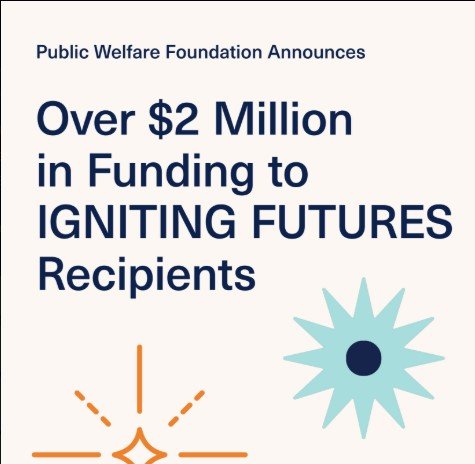
In January, PWF announced its IGNITING FUTURES: A Youth Justice Grant dedicated to funding local youth justice coalition work to advance transformative change, defend rollbacks, and sustain reforms.
Earlier this week, we announced $2M in funding to IGNITING FUTURES recipients. pic.twitter.com/aYRvEvl4yr
— Public Welfare Foundation (@PublicWelfare) May 21, 2026
Meanwhile, the Michigan Center for Youth Justice will lead a $1 million coalition alongside Wayne State University Center for Behavioral Health and Justice and The Delta Project. The group will focus on expanding diversion programs, strengthening the state’s Child Care Fund model, while reducing youth entry into the justice system through early intervention and community-based services.
The Foundation framed the investments as part of a broader effort to reinforce reforms that remain politically and structurally vulnerable.
“We know that communities with robust, united, and resourced youth justice coalitions are more prepared to advance transformative change, defend rollbacks, and sustain reforms,” said Thena Robinson Mock, Vice President of Programs at Public Welfare Foundation. “Through the Igniting Futures grants, we are investing in promising coalitions, expanding their capacity to build a truly just and safe future for young people.”
The funding arrives at a time when juvenile justice systems across the United States face renewed scrutiny over racial disparities and uneven access to diversion programs.
Implementation becomes the focus of reform funding
Rayment told Charity Journal that the initiative is less about introducing new policy models and more about improving the implementation of existing youth justice frameworks at the state level.
She pointed specifically to structures like Michigan’s Child Care Fund, noting that such mechanisms are not new, but often fail to achieve impact at scale due to weak coordination and limited operational capacity.
The Igniting Futures model shifts funding toward coalition infrastructure, communications systems, and cross-sector alignment.
“The learnings and outputs of the coalition’s work will benefit organizations across the country that are also working to strengthen local continuums of care using these types of models,” Rayment told Charity Journal.
Public Welfare Foundation’s approach reflects a broader trend among major funders moving away from fragmented program grants and toward systems-level investments that prioritize coordination between nonprofits and state agencies.
Coalitions positioned as long-term infrastructure for youth justice
Both coalitions will use grant funding to build operational systems that support long-term collaboration, including shared communications strategies and cross-organization coordination frameworks.
In Tennessee, organizers describe the effort as a shift toward a youth justice system that prioritizes care and stability over incarceration, while Michigan leaders frame their work as moving from policy design to implementation at scale.
“This grant will help our coalition deepen partnership across advocates, organizers, and directly impacted leaders to advance solutions that honor young people’s humanity,” said Jennifer Rodriguez, Executive Director of the Youth Law Center.
Jason Smith, Executive Director of the Michigan Center for Youth Justice, said the Michigan coalition will strengthen cross-system collaboration and expand preventive services that reduce youth involvement in the justice system.
“At a pivotal moment for youth justice in Michigan, this grant allows us to move from policy promise to meaningful practice,” Smith said. “We are building a coalition that centers youth and families, strengthens cross-system collaboration, and helps communities invest in supports that prevent system involvement in the first place.”
The Foundation also awarded a grant to Catalyze Justice to provide technical assistance and learning support across the cohort, reinforcing its emphasis on shared infrastructure and knowledge transfer.
Public Welfare Foundation said it expects the coalitions to generate implementation insights that can be replicated across other states seeking to expand non-carceral youth justice systems.