

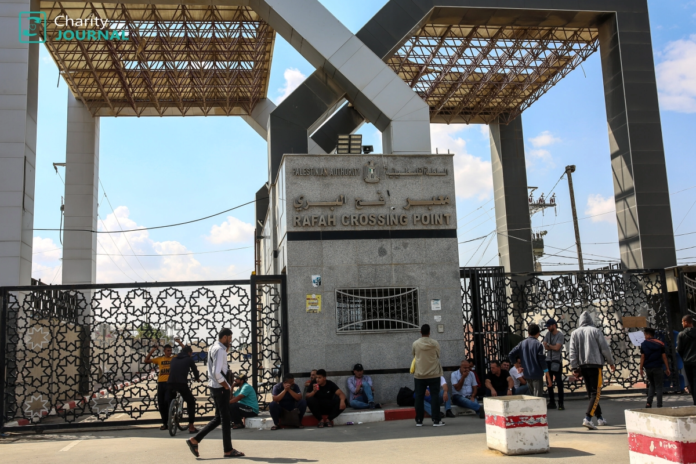
Foreign policy and humanitarian expert Jasmine El-Gamal, has condemned the stringent regulations imposed on Palestinian civilians attempting to return to the Gaza Strip through the Rafah crossing. She described the regulations as draconian and evil, questioning both their justification and their crippling impact on recovery.

Rafah crossing: Draconian return rules and destroyed infrastructure stifle recovery
El-Gamal in post on X, said the rules, which analysts say appear designed to dissuade returns, permit only a single suitcase of clothes per person. It also enforce a cash limit of $640 approved a day in advance, and ban items including water, and even children’s toys.
She also emphasized that authorities have routinely discarded belongings exceeding the arbitrary limits.
“What justification exists for any of this? How are people expected to rebuild their lives with one suitcase of clothes and barely anything else? Is this all just meant to dissuade anyone from returning,” El-Gamal questioned.
Echoing the Rafah Crossing condemnation, Ori Goldberg, a professor of Middle Eastern studies, who has spent the past two years analyzing Israel’s military campaign in Gaza, dismissed any official rationale. He said there is no justification for describing it as just evil.
Findings by Charity Journal reveal that the criticism of the crossing rules coincides with reports of further degradation of Gaza’s civilian infrastructure.
UN chief urges full ceasefire implementation and aid access
According to a post by Younis Tirawi on X, Israeli forces today demolished the Morag Water Station in Rafah. Before the war, Gaza’s water utility stated the station, inaugurated in 2010 with support from the Turkish Red Crescent.
They supplied water to approximately 70,000 residents, roughly one- third of Rafah’s population. As recently as February 2025, Oxfam and the utility had conducted a site visit to assess urgent repairs for its rehabilitation.
Meanwhile, United Nations Secretary-General Antonio Guterres underscored the deteriorating situation. He revealed that more than 500 Palestinians have been killed in Gaza since last October’s ceasefire agreement.
“I urge all parties to implement the agreement in full, comply with international law, and allow unimpeded passage of humanitarian relief at scale,” Guterres said.
Observers, however, note that the combined effect of restrictive return policies, severely undermines any prospect for displaced Palestinians to secure safe return or rebuild shattered lives. This also includes the destruction of critical infrastructure like water stations, and ongoing violence.
In a related development, a top international lawyer and former United Nations official, Francesca Albanese, has declared that Israel possesses no legal authority over the Gaza Strip. The former UN official accuses Israel of systematically creating conditions to destroy the Palestinian population.
Similarly, a coalition of eight Arab and Islamic nations has issued a forceful condemnation of Israel’s repeated Gaza ceasefire violations. The concurrent crisis deepens for Palestinian refugees in occupied East Jerusalem following the targeted disruption of vital UN agency services.