

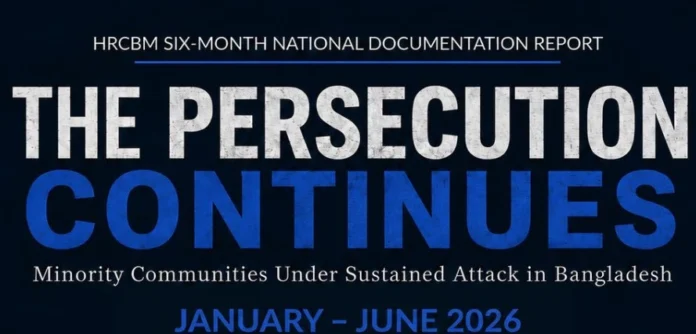

Religious and ethnic minorities in Bangladesh experienced 824 documented incidents of violence, intimidation, and rights abuses during the first half of 2026, according to a new report released by the Human Rights Congress for Bangladesh Minorities (HRCBM). Amid the streak of incidents, the organisation said it is pursuing United Nations mechanisms and domestic litigation to push for an independent inquiry into what it describes as a persistent pattern of persecution.
Human Rights Congress for Bangladesh Minorities report alleges widespread abuses across Bangladesh
The Human Rights Congress for Bangladesh Minorities, a nonprofit that documents human rights violations against religious and ethnic minority communities, said it recorded incidents in 63 of Bangladesh’s 64 districts between January and June.
Its six-month report documented 168 murders and suspicious deaths, 223 kidnappings and physical assaults, 41 cases of sexual violence, 141 attacks on places of worship, and 234 incidents involving land seizures, arson, looting, or property dispossession.
In response to questions from Charity Journal, HRCBM said it has continued pressing for international scrutiny after years of limited progress through domestic institutions.
“We continue engaging UN Special Procedures, OHCHR, the UN Resident Coordinator, diplomatic missions, parliamentarians, governments and international human-rights institutions while advocating for an independent Commission of Inquiry with credible international observation,” the organisation told Charity Journal.
HRCBM added that it submitted evidence to the Office of the Prosecutor of the International Criminal Court in 2022 and has continued filing supplementary documentation, including the latest report, despite receiving no further response.
Volunteers help victims document cases and seek justice
Beyond documenting abuses, HRCBM said its nationwide network of volunteers often becomes the first source of assistance for victims when local authorities fail to respond.
The organisation told Charity Journal that field observers help victims file police complaints, document evidence, access legal representation, and identify urgent humanitarian needs following attacks, displacement, or property destruction.
“Our field observers do more than verify incidents,” HRCBM told Charity Journal. “They frequently assist minority victims when local authorities are unresponsive, reluctant to register complaints, or fail to take meaningful action after violence, intimidation, land seizure, or other abuse.”
The network also preserves witness testimony, photographs, videos, court records, and police documents while withholding sensitive identities when disclosure could place victims or witnesses at greater risk. According to HRCBM, the evidence supports ongoing litigation and could be used in any future national or international accountability process.
Limited resources remain a barrier to accountability
Human rights organisations documenting abuses against minority communities often face the dual challenge of collecting evidence while providing emergency support to victims. Both tasks become more difficult when investigations stall, or legal systems fail to respond promptly.
HRCBM told Charity Journal that its work relies largely on volunteers operating with limited financial resources across Bangladesh. The organisation said political influence, administrative delays, institutional resistance, and threats from extremist actors continue to restrict its ability to expand legal aid and victim protection.
Despite repeated appeals to United Nations offices, foreign diplomatic missions, and other international institutions, HRCBM said it has not received meaningful support for its humanitarian or legal work.