

Each year, thousands of new osteosarcoma cases are diagnosed worldwide, a rare but aggressive bone cancer that disproportionately affects children and adolescents. Despite affecting hundreds in the US, osteosarcoma remains underfunded compared to other cancers, a gap that MIB Agents is working to close through advocacy, research funding, and patient support.
For many patients, osteosarcoma treatment often results in life-altering surgeries, including limb amputation or limb-salvage procedures. Young patients are faced with the steep mountain of surviving cancer while adapting to the new realities of limb loss.
It is into this reality that MIB Agents was formed and from within it that its most forceful advocates have emerged.
This April, as the country marks Limb Loss and Limb Difference Awareness Month, MIB Agents’ Junior Advisory Board (JAB), a cohort of young osteosarcoma patients and survivors aged 15 to 20, is working to close the awareness gap. The Board, comprising young osteosarcoma patients and survivors, is using lived experience, peer networks, and grassroots lobbying to bring visibility to a cancer that often goes overlooked.
How the MIB Agents Junior Advisory Board is driving awareness
The Junior Advisory Board is not a ceremonial body assembled to lend a human face to a nonprofit’s annual report. It is, by the MIB Agents’ own account, its North Star, determining whether programs are working and whether the needs of young cancer patients are being met.
Each member brings to the table what no clinical researcher or policy expert can replicate: the lived experience of osteosarcoma, comprising multiple visits to the oncologist or waking up from surgery with a missing limb and going back to school.
“Living with osteosarcoma has been eye-opening to my life,” said Inaaya Shariq, a JAB member who has become one of the board’s most prominent voices.
“I hate cancer more than the next person, but I am grateful for the perspective it gave me. I genuinely think that I wouldn’t be the person I am today without it. Cancer gave me community, friends, family, opportunities, rooms where I can be heard and help others be heard,” said Shariq.
According to Shariq, the new perspective forms the foundation of her understanding of advocacy itself. For Shariq, osteosarcoma advocacy is a moral obligation, with the JAB providing a platform to make a difference.
For Limb Loss and Limb Difference Awareness Month specifically, Shariq sees the public dimension of her amputation as both a burden and an opportunity to raise awareness. As a teenager, she has grown accustomed to the looks and silence that follow them.
“As a teenager with a very noticeable amputation, I can see the hesitation to ask my story,” Shariq told Charity Journal.
Without hearing her side, speculation swirled that her condition was a result of a car crash, a shark incident, or even fetal alcohol syndrome. Awareness, she argued, exists to replace that assumption with understanding, curiosity, and basic human empathy.
Pushing the limits of osteosarcoma advocacy
While the Junior Advisory Board’s influence within MIB Agents has grown since its founding, it was an unexpected afternoon in Washington, D.C., in the spring of 2024 that cemented its place.
At the time, the board was invited to present a patient panel at the White House for the Cancer Moonshot Team, and separately at the National Institutes of Health in Bethesda, Maryland.
With a rare free day on their calendar, Nancy Goodman, founder of Kids V Cancer, asked whether they might be willing to visit their congressional representatives on Capitol Hill to advocate for the Give Kids a Chance Act, legislation aimed at expanding access to promising cancer treatments for pediatric patients.
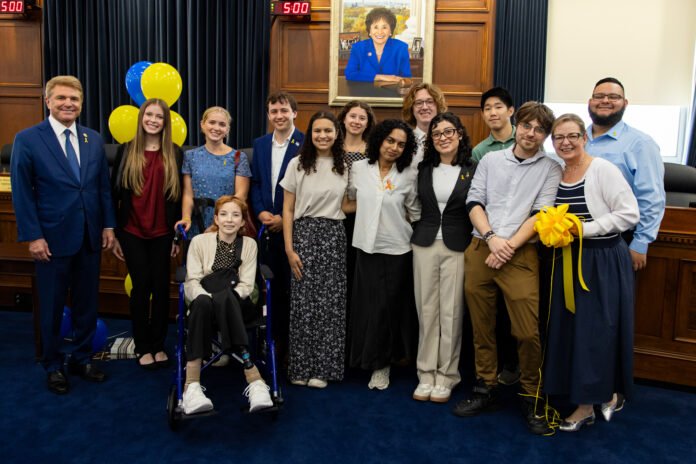
JAB accepted, and the results of the meeting surpassed expectations. The teenagers, many of them visibly marked by their treatment, walked into congressional offices and walked out with co-sponsorships that seasoned advocates had not anticipated.
In September 2024, JAB received an invitation to lead more than 100 children and young adults on Kids V Cancer’s Climb the Hill. JAB member Penelope Abellera also made the trip to Washington during the final weeks of her life, joining other JAB members to lead the walk.
The following September, JAB member Mikaela Naylon arrived on Capitol Hill after exhausting her curative treatment options. The 16-year-old Naylon and JAB led the Climb the Hill event in 2025 with over 150 kids and young adults in attendance.
Mikaela spent most of the day meeting with congressional representatives and securing co-sponsorships, teeing up the Give Kids a Chance Act for success. Mikaela passed away on October 29, 2025, and barely four months later, the Give Kids A Chance Act was signed into law.
The law, designed to accelerate the development of new treatments for pediatric cancer, was renamed in her honor: the Mikaela Naylon Give Kids A Chance Act. Both Penelopea nd Mikaela had fought for a bill they knew would never help them, but they did it for the children who would come after.
Preparing for the next battle
The passage of the Mikaela Naylon Act is a milestone that the organization is still absorbing. However, the Junior Advisory Board is looking ahead to the next crisis, one that is, in some ways, immediately urgent.
“While we celebrate this milestone, we are discerning what our next bill to tackle will be,” said the organization. “One critical hurdle our Junior Board has seen the effects of is the nationwide crisis of cancer drug shortages.”
Across the US, a shortage of critical cancer medications is threatening the treatment of pediatric patients. Vincristine, key for the treatment of leukemia, is often in short supply, so hospitals are forced to ration doses.
Meanwhile, Methotrexate, Cisplatin, and Etoposide, drugs used to treat osteosarcoma and brain cancer, have faced similar shortfalls. In a single year, 23 active cancer drug shortages were reported nationwide.
For adults with cancer, a delayed or altered treatment protocol is serious. For a child, the effects are catastrophic. In an interview with Charity Journal, JAB says ensuring a stable and reliable supply of medicines for children with cancer is emerging as its next legislative priority.
While the JAB has drug shortages in its crosshairs, it has yet to select it as a key legislation to focus on. The board, having now demonstrated that it can move Congress, is not short on determination.
Building a leadership pipeline that lasts
One of the quieter challenges facing any youth-led organization is continuity. Young people grow up. They leave for college, start careers, and begin lives that pull them in new directions.
For years, members who have aged out of the Junior Advisory Board, which caps membership at 20, reported feeling adrift. Aware of this, the organization launched NextGen, a pilot program open to former JAB members between the ages of 21and 25.
“I feel like I have lost my community,” said ex-JAB members to MIB Agents.
The program offers a structured way for ex-JAB members to remain connected, mentoring current board members while receiving mentorship themselves from leaders in their chosen field.
Since its launch in June 2025, NextGen has bagged a string of early successes. Out of the program’s 13 current members, eight are pursuing medical degrees at institutions including Harvard, Dartmouth, Tufts, the University of Michigan, and the University of Wisconsin-Madison.
Others are building careers in law, transportation, and nuclear energy. All of them, in one form or another, are carrying forward what osteosarcoma taught them.
Funding the science while putting the patient at the center
Alongside its advocacy work, MIB Agents is also pressing on with research funding. The organization’s OutSmartin Osteosarcoma grant requires that every funded project pass the Patient Impact Score, a measure assessed in part by nearly 60 family fund holders, including bereaved families, who serve as stakeholder reviewers.
The central idea behind this is to ensure that high-level bench science does not lose sight of the people it is ultimately meant to help.
The organization is also part of a $15 million initiative called Radical Collaboration, undertaken in partnership with Break Through Cancer. The effort brings together researchers from Dana-Farber Cancer Institute, Johns Hopkins, UT MD Anderson Cancer Center, Memorial Sloan Kettering, and the Koch Institute at MIT in what the organization describes as the largest coordinated initiative in history to advance osteosarcoma research.
It is an ambitious bet that connecting the right institutions and the right patient voices will produce something that funding alone never can.
What awareness actually means
On its own, awareness can feel like a thin consolation or a hashtag or a ribbon color. The members of the MIB Agents Junior Advisory Board know this better than most. They have buried friends while others have watched legislation move slowly through a system that was not designed with sick teenagers in mind.
JAB members have done all of this while managing their own recoveries and their own re-entries into ordinary life. Despite the headwinds, they keep showing up, to Capitol Hill, to the White House, to NIH conference rooms, and to the funerals of people they loved.
This April, as Limb Loss and Limb Difference Awareness Month unfolds across the country, MIB Agents and its Junior Advisory Month are pushing new frontiers. For them, awareness is only meaningful when it leads somewhere, to legislation or research, or to a child somewhere receiving the medicine they need on the day that they need it.