

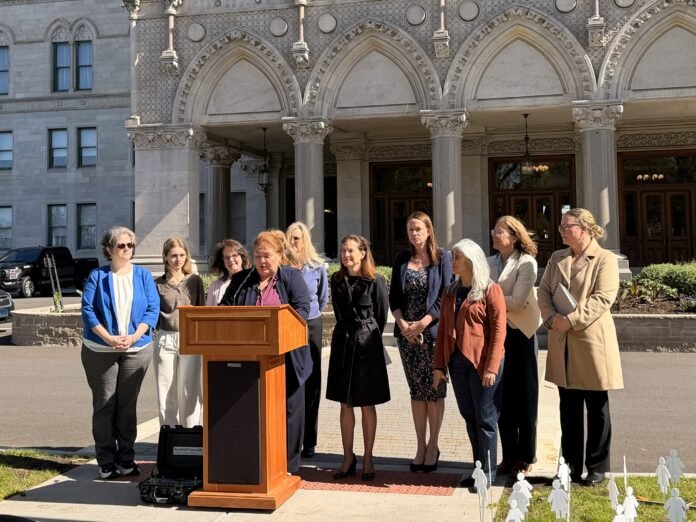

Connecticut lawmakers voted unanimously on April 28 to pass Senate Bill 259, banning female genital mutilation and cutting (FMG/C) in the state after six failed attempts spanning nearly a decade. Equality Now says it will lean on the lessons from Connecticut as it takes the fight to the eight remaining states without a law explicitly banning the practice.
Seven years to a unanimous vote
Connecticut’s path to Senate Bill 259 runs through six collapsed attempts dating back to 2018, with proposed bills dying in committee, one rejected by the State Senate, and another never raised to the House floor.
Democratic State Representative Jillian Gilchrest introduced the current bill in February 2026, backed by a coalition of survivor leaders, medical professionals, and human rights organizations that had been building its case for years.
The bill establishes FGM/C as a criminal offense in Connecticut and introduces a set of survivor-centered protections that advocates had long pushed for. According to the provisions, victims aged 12 or younger can testify outside the courtroom, and no victim can be deemed automatically incompetent to testify because of their age.
Furthermore, survivors can pursue civil action up to 30 years after reaching the age of 18. In addition, the bill waives parent-child immunity in FGM/C cases and allows civil action by victims.
More than 2,500 women and girls in Connecticut have undergone or face risk of FGM/C, giving the state the largest at-risk population in the US among states without a ban. Once Governor Ned Lamont signs the bill into law, Connecticut will become the 42nd state to explicitly prohibit the practice.
“The unanimous passing of Senate Bill 259 is the culmination of six years of campaigning by survivors, advocates, and civil society organizations,” said Anastasia Law, Legal Advisor for North America at Equality Now. “By criminalizing FGM/C, this law will bring meaningful protections for thousands of women and girls and strengthen access to justice for survivors.”
Equality Now pledges implementation measures
In an interview with Charity Journal, Law argued that while passing the bill closes a legal gap, it does not automatically build the infrastructure survivors need to use it.
Critics point out that Senate Bill 259 includes no educational or outreach provisions, and advocates acknowledge that implementation will determine how much of the law’s promise translates into actual protection.
The Connecticut Coalition to End FGM/C, which includes Equality Now, Sahiyo, the US End FGM/C Network, and the Connecticut Children’s Alliance, plans to drive that implementation work forward. Sahiyo and the US End FGM/C Network already work closely with survivors, service providers, and state actors, giving the coalition an operational foundation to build from as the law takes effect.
“Survivors need to know that coming forward, whether through a civil suit or the criminal route, is an option for them and that there will be systems in place to offer support should they decide to do so,” said Law.
The coalition also intends to continue strengthening the law itself, pushing for the holistic provisions that this version of the bill did not include.
Eight states still without a ban
Alabama, Alaska, Hawaii, Maine, Mississippi, Montana, Nebraska, and New Mexico carry no explicit state ban on FGM/C, and advocates in those states face the same structural obstacles that stalled Connecticut’s efforts for years.
In her interview with Charity Journal, Law identified three recurring roadblocks standing in the way of legislative reform. Right off the bat, she noted that a lack of awareness that FGM/C occurs within specific communities and harmful misconceptions about who practices it.
Also, the Equality Now executive highlighted an increasingly damaging conflation of FGM/C with gender-affirming care that undermines both causes.
Law noted that Connecticut’s coalition encountered all three narratives and spent years countering them with survivor testimony and data. That approach, grounding the argument in lived experience rather than abstract policy, is what Law points to as the most transferable lesson for advocates in the remaining states.
“Our work in Connecticut and elsewhere is driven and led by survivors, and that is what keeps us coming back year after year,” said Law.
In March 2026, the Inter-American Commission on Human Rights called on governments, including the United States, to strengthen their responses to FGM/C through prevention, survivor support, and sustained investment. Connecticut’s unanimous vote is one answer to that call. The eight states that have not yet acted represent the unfinished portion of it.