

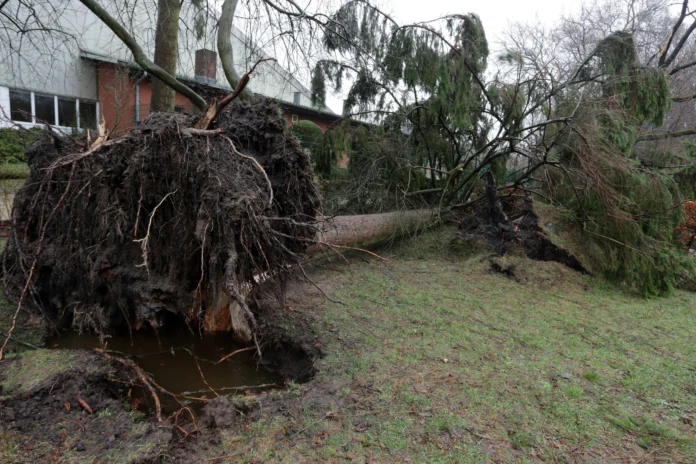

Governor Ned Lamont, US Senator Richard Blumenthal and US Representative Jahana Hayes surveyed storm damage in Harwinton on Tuesday, pledging to pursue federal aid for communities hit hardest by July 4th weekend storms. The storms left downed trees, snapped power lines and golf ball-sized hailstones across Harwinton and Torrington, knocking out power to tens of thousands of Connecticut residents.
Damage described as tornado-like across two towns
Lamont described the scale of destruction in Harwinton as resembling a tornado strike, with trees toppled one after another along entire streets. Utility provider Eversource said it restored power to more than 155,000 customers across the state, though more than 200 households in Harwinton remained without power Tuesday afternoon.
Heartbreaking to see the damage from Saturday’s storm as I met with residents in Torrington and Harwinton today. We’re pushing utilities to restore power ASAP, bringing in extra crews, and making sure town leaders have what they need. Grateful to our crews and first responders. pic.twitter.com/oaFv9G1gsE
— Governor Ned Lamont (@GovNedLamont) July 7, 2026
Torrington Police Chief William Baldwin said the north end of the city sustained uprooted trees, fallen limbs and cars struck by hailstones measuring up to three inches in diameter. Harwinton’s town hall remained open as a cooling center, providing bottled water and device charging stations while municipal buildings stayed closed.
“You just see tree litter all over the place. It’s everywhere. You see limbs down, you see people’s yards that they’ve maintained so well, just a complete mess,” Baldwin said.
Eversource reported that lingering wet weather following the initial July 4th storm generated approximately 22,000 new customer outages and blocked 52 roads, slowing the pace of repairs.
Federal aid options include FEMA, SBA and SNAP benefits
Blumenthal outlined three potential federal aid channels available to affected residents: the Federal Emergency Management Agency, the Small Business Administration and SNAP food benefits. He urged residents to document and photograph all damage to their homes and businesses immediately to support both insurance claims and federal assistance applications.
“We’ll leave no stone unturned in terms of federal aid,” Blumenthal said. “The magnitude and the scope and scale of what we’re seeing certainly warrants federal relief.”
Hayes stressed that smaller towns face a particular challenge in accessing federal aid because their populations may fall below standard eligibility thresholds. Her remarks reflect a structural tension that community resilience advocates have flagged repeatedly, including in the work of organizations building permanent disaster preparedness infrastructure for underserved communities.
“It’s important for the state and federal partners to work together, because these are really small towns,” Hayes said. “By comparison, the population isn’t as large, so they may not meet the threshold on their own.”
Blumenthal also warned residents to hold insurance companies accountable for storm damage payouts. The full scope of the federal aid application process and the organizations best positioned to support affected households is outlined in resources from nonprofits specializing in US disaster relief and recovery.