

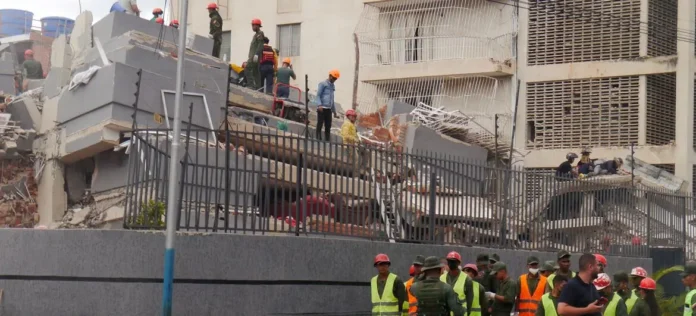

An international fleet of military and government aircraft has been moving humanitarian aid in Venezuela since twin earthquakes struck the northern coast on June 24. Ground access to isolated communities remains limited, making air transport the primary channel for food, water and emergency supplies.
How the aerial humanitarian aid operation in Venezuela took shape
US Marines flew Bell Boeing MV-22B Osprey tiltrotor aircraft on July 1 to deliver food and water to Simón Bolívar International Airport in Caracas. US Navy vessels positioned in the Caribbean have provided logistical support throughout the operation.
U.S. Contingency Response Element Airmen, assigned to the 621st Contingency Response Wing, offload cargo from a Strategic Airlift Capability Heavy Airlift Wing C-17 Globemaster III at Simón Bolívar International Airport, Venezuela, July 2, 2026.
At the direction of #SOUTHCOM,… pic.twitter.com/AXFfGGXRSt
— U.S. Southern Command (@Southcom) July 7, 2026
The 621st Contingency Response Wing deployed a 110-airman element to the airport to assess runway capacity and coordinate the intake of heavy cargo aircraft. US Air Force C-17 Globemaster and C-130 Hercules planes have since run continuous supply flights. US Southern Command described the Hercules as proving indispensable for moving massive payloads of equipment into the country.
Bell UH-1Y Venom and Boeing CH-47 Chinook helicopters have also joined operations, with Chinooks prepped at Soto Cano Air Base in Honduras for rapid deployment. The Venezuelan air force deployed its own Mil Mi-17 helicopters to reach communities where fixed-wing aircraft cannot land. That dual-track approach has allowed aid to reach areas cut off by collapsed roads and damaged infrastructure, a challenge nonprofits providing disaster relief around the world consistently face after earthquakes in countries with pre-existing infrastructure deficits.
Ground access and airport repairs shape the pace of aid delivery
Simón Bolívar International Airport sustained significant damage in the earthquakes. Ceiling panels fell, debris scattered across the terminal and power outages initially prevented full operations.
US forces delivered a high-capacity loader to speed up cargo offloading and enable faster distribution to affected communities. Nearly 2,000 US military personnel are supporting the State Department-led relief mission, with logistics hubs established in Puerto Rico and Curaçao. The Humanitarian Assistance Coordination Center is overseeing the military component and coordinating with Venezuelan authorities, allied partners and civilian agencies.
The scale of the aerial response mirrors patterns seen in previous hemisphere-wide disasters, where the largest humanitarian organizations have relied on military airlift capacity to move aid volumes civilian logistics alone cannot sustain.