

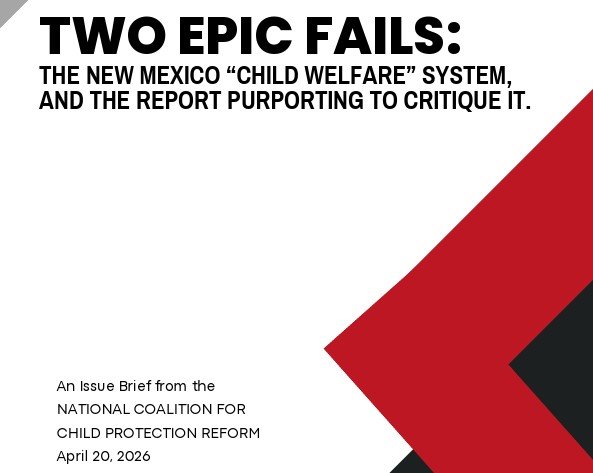

The National Coalition for Child Protection Reform (NCCPR) is pushing back against a sweeping report on New Mexico’s child welfare system. While New Mexico’s AG is gearing up to sue the state’s child welfare system on the basis of the report, the NCCPR says the document missed the mark entirely.
NCCPR says New Mexico’s AG got child welfare wrong
The NCCPR has released a rebuttal to Attorney General Raul Torrez’s report on the state’s Children, Youth and Families Department (CFYD). Taking a swipe at the report, the NCCPR noted it misunderstands basic data and uses “ugly” language to stereotype families.
The 224-page report followed a year-long investigation by the Justice Department into the affairs of the CYFD in the wake of a 16-year-old boy’s death by suicide at a group home contracted to house foster children.
While NCCPR does not dispute that CYFD is struggling, the child advocacy group disagrees with the AG’s reason.
For Torrez, the agency’s failures stem from an ideological bias toward keeping families together at the expense of child safety. Meanwhile, the NCCPR in its rebuttal says that framing obscures the actual drivers of the crisis.
The numbers at the center of the dispute are striking. In 2024, 80% of children placed in foster care in New Mexico faced no allegation of physical or sexual abuse. In 59% of cases, there was no allegation of drug abuse of any kind.
More children entered foster care that year due to inadequate housing than due to physical and sexual abuse combined. In a 220-page report about child welfare in the state with the highest child poverty rate in America, the word poverty does not appear once.
When poverty is mistaken for neglect
The distinction between poverty and neglect determines whether a family receives help or loses its children. For housing instability, one of the leading triggers for removal, NCCPR executive director Richard Wexler points to cash as a straightforward solution.
“There is nothing like the transformative power of cash,” said Wexler. “Study after study shows that even small amounts of cash can make a huge difference.”
Wexler hinged his argument on Chapin Hall’s research, noting that housing vouchers also recorded impressive levels of success. According to Wexler, child care subsidies can also curb removals filed under “lack of supervision.”
The stakes extend beyond New Mexico. A bird’s-eye view indicates that children left in their own homes fare better in later life than comparably maltreated children placed in foster care.
One study found that foster youth were four times more likely to die by age 20, with suicide the most common cause of death. By centering abuse horror stories and framing the system’s leniency as its core flaw, Wexler argues that Torrez’s report diverts political will from the interventions that could actually work.
The missing voices in the report
The most pointed critique in NCCPR’s rebuttal is about who was absent from the attorney general’s investigation entirely, with birth parents and foster youth noticeably missing. Wexler warned that without those perspectives, reform efforts will continue to reflect the views of agencies and law enforcement rather than those of affected families.
“One year ago, just as Attorney General Torrez was beginning his investigation of the New Mexico Children, Youth and Families Department, we warned that his investigation would fail if it left people out,” said Wexler. “He left people out. The investigation failed.”
Building that advocacy infrastructure in New Mexico will not be easy, says Wexler. The NCCPR executive director pointed to a lack of active family advocacy in New Mexico while aware of the limited capabilities of his organization.
“There seems to be no robust family advocacy movement in that state,” said Wexler. ” NCCPR is too small to help such groups get started.”
With savings in reduced foster care, Wexler calls for additional funding for other agencies to support the state of child welfare.
However, Torrez’s report gets some things right, particularly its criticism of CYFD’s culture of secrecy. But on the central question of what is driving the agency’s failures, NCCPR argues he has drawn the wrong conclusions from the wrong evidence.