

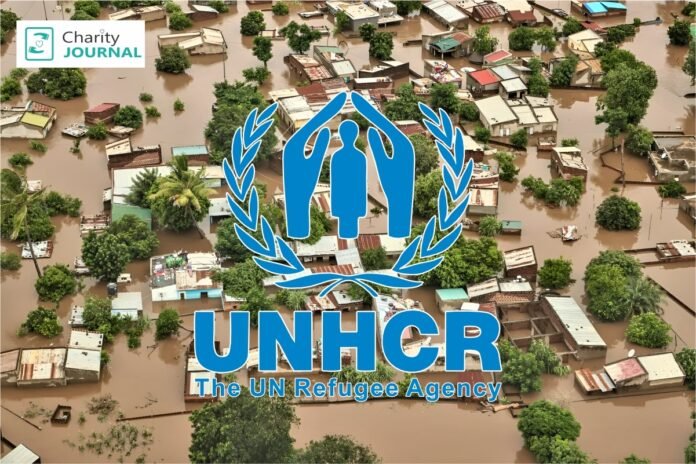

The United Nations High Commission for Refugees (UNHCR) has said rampant flooding has displaced over 600,000 people across southern Mozambique.
The agency confirmed that waters are still rising and urgent humanitarian access is now the critical challenge. It also notes that it is scaling up support for a government-led response as families flee submerged homes and needs escalate by the hour.
UNHCR Says Gaza Province Worst Hit By Flooding
According to UNHCR and Relief Web reports, a staggering 75 percent of the affected population resides in Gaza Province. Floodwaters have severed key road links, crippling supply chains and hampering ground relief efforts.
Findings by Charity Journal reveal that the main highway connecting the capital, Maputo, to the rest of the nation has sustained damage, creating major access bottlenecks.
“Air and maritime assets are now urgently needed to deliver life-saving supplies and reach cut-off communities,” a UNHCR situation report stated.
The agency highlighted that high-volume releases from dams are exacerbating river levels, causing flooding to spread to new areas.
Since 2017, conflict driven by non-state armed groups has uprooted over 500,000 people in northern provinces like Cabo Delgado, Nampula, and Niassa. Mozambique also hosts approximately 23,000 refugees and asylum-seekers.
UN Agencies Warn of Compounding Crises
As one of the world’s most climate-vulnerable nations, Mozambique now faces a dual emergency of conflict and climate shocks. Extreme weather events, including cyclones, floods, and droughts, displaced thousands more by the end of 2024.
UNHCR, alongside government and development partners, is working to support displaced communities across the north and in refugee-hosting areas. Their efforts combine immediate disaster response with longer-term resilience building.
Meanwhile, humanitarian actors have outlined several critical priorities, including rapid deployment of air assets for search-and-rescue operations and reaching isolated populations.
They also outlined the mobilization of civil engineering and disaster management specialists. This is to temporarily restore access routes and bolster flood defences.
In a related development, UNICEF Chief of Communication in Mozambique, Guy Taylor, said when floods strike, as they have repeatedly over the past years, the youngest are hit hardest, both in the first days of an emergency and in the months and sometimes years that follow.
Similarly, the severe flooding in Burundi has sent many people away from their homes across several regions. However, funding from the United Nations Central Emergency Response Fund (UNCERF) has provided relief efforts in the affected communities.